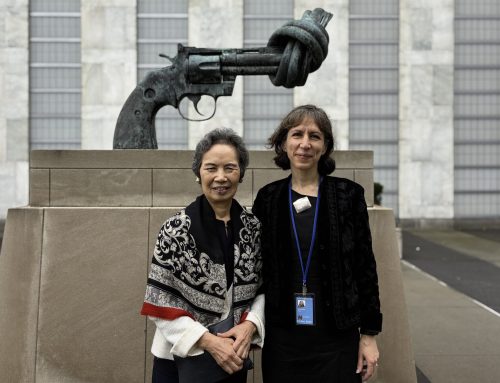
Hope to me comes from activism of communities affected by nuclear weapons and from conversations at every level.
These remarks were delivered by Ivana Nikolić Hughes to close the Choose Hope side event at the 11th Review Conference of the Nuclear Non-Proliferation Treaty on April 30. The event was co-organized by the Nuclear Age Peace Foundation and Soka Gakkai International, and co-sponsored by the Missions of Philippines and Kiribati.
I want to begin by sharing a personal anecdote from just this morning. I woke up to a text message from my daughter that simply said, in all caps: PASSED. Inge is a sixth-year medical student at the University of Belgrade in Serbia, and at around 3 a.m. New York time she was taking her very last exam of medical school. So, of course, the news that she passed was incredibly exciting—and all the more special because today also happens to be my husband’s and my 25th wedding anniversary.
As I went about my morning feeling enthused and happy, I was in the kitchen when, let’s just say, a glass jar full of decaf coffee went flying through the air and shattered into pieces, with one of my fingers managing to encounter one of the shards and to start bleeding profusely. I’m glad to report that after some pain—and a lot of gauze and tape—my finger seems to be okay, although the same certainly cannot be said for the coffee jar.
Why am I telling you this? To me, this story illustrates two things about our world. First, that it is filled with personal achievements and milestones—a world in which we are fortunate to witness births, weddings, graduations, job offers, pet adoptions, and family reunions. It is a world that humans have built over centuries and millennia by working together, seeking knowledge and understanding, building cities like the incredible New York we are all in today, and preserving rainforests in the Amazon, through achieving and celebrating milestones. And often, the personal is also communal. Today may be a big day for my daughter as an individual, but her degree and her commitment to medicine will enable her to help countless people into the future as she treats patients and works to improve their physical and mental health.
The second thing this story illustrates has to do with the coffee jar. Although far from a tragedy, the broken jar incident reminds us that things can and do go wrong—often when we least expect them. Sometimes we are lucky enough to have reasons to celebrate, and that is all well and good. But too frequently—especially these days—it feels as though numerous things are going wrong, leaving behind shattered communities, innocent victims, and broken ecosystems. A flying coffee jar made a mess in my kitchen, and I soon found myself thinking about what it would be like to try to clean up my apartment if my building had been bombed and I had been lucky to survive. I thought about the aftermath and the cleanup of Hiroshima and Nagasaki, both of which I have been very fortunate to visit on two recent trips to Japan, including last August for our Choose Hope Symposium.
Nuclear weapons may be just one of the many problems facing our world, just one of the things that could go wrong, but they are also the most dramatic—and I am ready to debate anyone who says otherwise. A nuclear war could destroy human civilization in a matter of minutes, and if you haven’t already, I would urge you to read Annie Jacobsen’s book, Nuclear War: A Scenario to understand exactly what this means. Nothing comes close to the scale or immediacy of the threat posed by these monstrous weapons of mass destruction. To underscore just a few basic facts: there are approximately 12,000 nuclear warheads in existence today, most of them far more powerful than the atomic bombs used in the U.S. attacks on Hiroshima and Nagasaki. Their impact would go far beyond the deaths and injuries in attacked cities, altering environmental conditions on our planet through effects of radiation, nuclear winter, and ozone layer destruction in unimaginable proportions.
So where does hope come from? Where can we find hope in such challenging times? To me, it comes from gatherings like this, from the inspiration we can draw in the immense legacies of Daisaku Ikeda, David Krieger, the hibakusha, and so many others who have spread a message of peace since the birth of the nuclear age. It comes from partnerships like that between the Nuclear Age Peace Foundation and Soka Gakkai International, and from those who support our work—believing, as we do, that a world free of nuclear weapons is not only necessary, but possible.
Hope also comes from the fact that more than half of all UN member states are now party to the Treaty on the Prohibition of Nuclear Weapons, and from young people like Anduin who are building connections between nuclear disarmament and climate action.
This evening, before we go out to celebrate our anniversary, my husband and I will attend a lecture at Columbia by Professor Anaïs Maurer, whose book The Ocean on Fire explores the legacy of Pacific activism in both nuclear disarmament and climate change. Hope to me comes from activism of communities affected by nuclear weapons and from conversations at every level—in university lecture halls, at dinner tables, in podcast studios, and at conferences like this one.
I wish to thank our friends at the Missions of Philippines and Kiribati and at Soka Gakkai International for their partnership, not only in putting this event together, but in pursuing a nuclear weapons free world and nuclear justice. I also want to thank the Honorable Ambassadors, Mr. Aishima, and our exceptional panelists for their wonderful contributions to today’s event and for their important work. To Mr. Matsuura – it is an honor to be with you and to learn from you. You and all of the hibakusha are an inspiration.
And thank you to all of you for being with us today and let me to invite you to join us in choosing hope and spreading a message of peace and disarmament.